
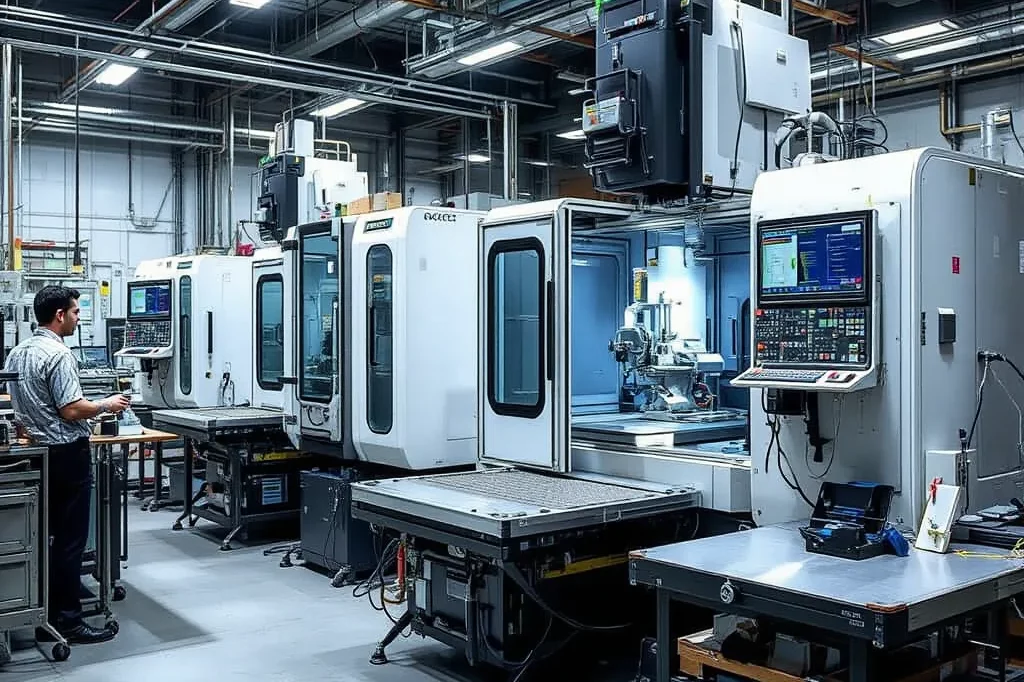
At a time when production accuracy and efficiency determine market share, manufacturing companies face the challenge of continuously optimizing their processes. Recent studies by the Fraunhofer Institute show that companies can increase their productivity by an average of 23% through the use of Big Data. CNC Center Northeim recognized this development early on and has been increasingly relying on data-driven manufacturing processes since 2022 to ensure precision and quality at the highest level.
Fundamentals of Data-Driven Manufacturing
The integration of Big Data into manufacturing processes enables a completely new dimension of production control. By installing state-of-the-art sensor technology on our CNC machines, we continuously capture over 1,000 data points per minute. These data include temperature trends, tool wear, vibration patterns, and material behavior. A McKinsey study from 2023 confirms that companies can reduce their scrap rate by up to 45% through such detailed data analysis. In our two-shift operation, this means significant cost savings while simultaneously improving quality.
Implementation of Big Data Analytics
Successfully integrating Big Data Analytics requires a well-thought-out implementation strategy. CNC Center Northeim has developed a three-stage system for this purpose: First, data collection is carried out using high-precision sensors on all 13 CNC machines. This data is transmitted in real-time to our central analysis platform, where it is evaluated using AI-supported algorithms. The third stage involves automatic process optimization based on the insights gained. Industry statistics show that such integrated systems can reduce lead times by an average of 35%.
Quality Assurance Through Real-Time Data Analysis
Continuous monitoring and analysis of production data allows for preventive quality assurance. Our systems detect deviations from target values before they lead to quality defects. This is particularly important when processing high-alloy steels and precision parts for the medical technology and aerospace industries. Real-time analysis enables us to automatically adjust parameters such as cutting speed, feed rate, and coolant usage. A recent analysis by the German Mechanical Engineering Industry Association (VDMA) confirms that companies using real-time data analysis can increase their first-pass yield rate by up to 30%.
Predictive Maintenance Revolutionizes Maintenance
By systematically evaluating machine data, we can identify potential failures early and take proactive action. Our maintenance intervals are no longer based on rigid schedules but on the actual wear condition of the components. This has led to a reduction of unplanned machine downtimes by up to 70%, as internal evaluations show. Predictive maintenance allows us to procure spare parts in a timely manner and optimally integrate maintenance work into the production process. Industry studies confirm that predictive maintenance can reduce maintenance costs by an average of 25%.
Conclusion and Outlook
The integration of Big Data into our manufacturing processes has proven to be a decisive competitive advantage. Through the continuous analysis and optimization of all production parameters, we can not only guarantee the highest quality standards but also respond flexibly to customer requirements. Investments in digital technologies and data analysis paid off after a short time: our productivity increased by 28% while the scrap rate dropped by 40%. These successes encourage us to consistently continue on the path of data-driven manufacturing and to continuously develop our systems further.


