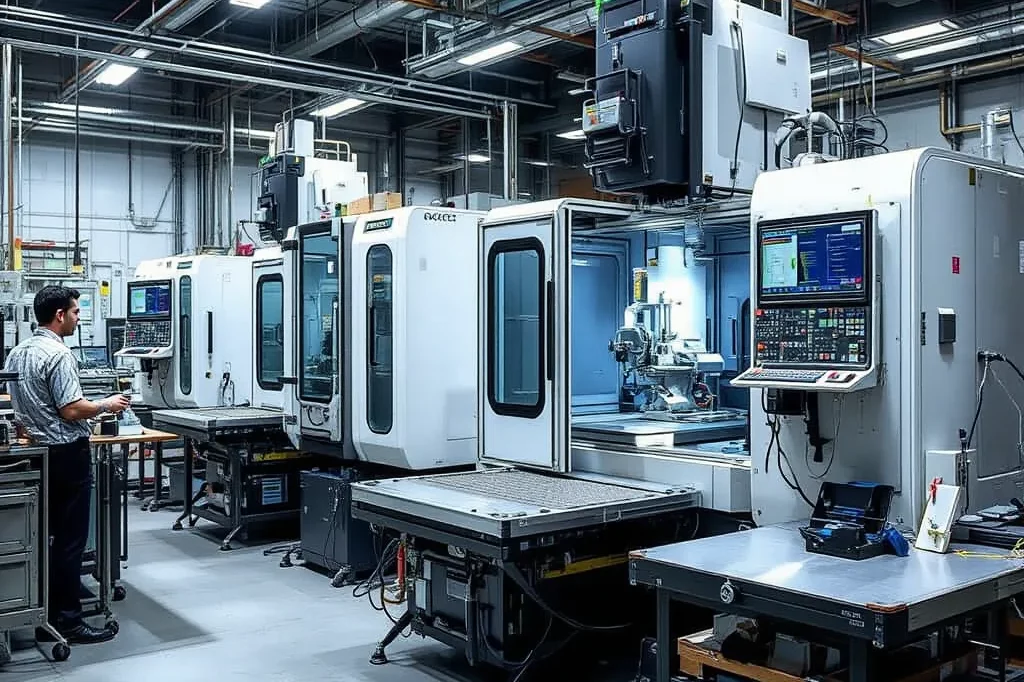

Control Components from CNC Manufacturing: The Path to the Smart Factory
Modern manufacturing is undergoing a significant transformation: Digitalization is not only changing the way products are made, but also how machines communicate with each other. At the center of this development are the control components of CNC manufacturing, paving the way to the smart factory.
The Evolution of CNC Control
Computer Numerical Control (CNC) has continuously evolved since its inception. Modern CNC controllers are no longer just responsible for the precise execution of machining programs, but are increasingly taking on tasks related to process monitoring and optimization. They feature powerful processors, large storage capacities, and high-resolution touchscreen displays that allow for intuitive operation.
Key Components of Modern CNC Controllers
The most important components of current CNC control systems include:
- Main computers with multicore processors
- Real-time-capable communication interfaces
- Integrated safety features
- Network connectivity for Industry 4.0
- Digital input and output modules
- Modern human-machine interfaces
Networking and Data Exchange
A key aspect on the way to the smart factory is the networking of control components. Modern CNC controllers feature standardized interfaces such as OPC UA or MQTT, enabling manufacturer-independent data exchange. These communication protocols allow production data to be captured, analyzed, and used for optimization in real time.
Integration into Higher-Level Systems
The control components must be seamlessly integrated into the company’s IT infrastructure. This includes connections to:
- Manufacturing Execution Systems (MES)
- Enterprise Resource Planning (ERP)
- Computer-Aided Manufacturing (CAM)
- Production planning and control systems (PPS)
- Quality management systems (QMS)
Predictive Maintenance and Process Optimization
Modern control components enable predictive maintenance through continuous data acquisition from machines. Sensors monitor key parameters such as temperature, vibration, and current consumption. This data is analyzed by the controller to detect potential disruptions early and prevent unexpected machine downtime.
Artificial Intelligence in CNC Control
The integration of AI algorithms into CNC controllers opens up new opportunities for process optimization. Machine learning makes it possible to identify patterns from historical data and automatically adjust machining parameters. This leads to higher product quality and greater manufacturing efficiency.
Practical Application in Everyday Manufacturing
The CNC Center Northeim GmbH relies on networked control components of the latest generation in its modern production. The integration of CAD/CAM systems with CNC controllers enables a continuous process chain from design to the finished workpiece. By networking the machines and implementing Industry 4.0 concepts, high manufacturing quality is achieved while simultaneously improving efficiency.
You can find this and more exciting articles on our website www.cnc-northeim.de